




A new boat, but not finished yet
We expect to find items to be improved on our new boat, and some items not done yet. For the commissioning and testing we have reserved two weeks of time, before we intend to sail home. It takes away the pressure from the shipyard and from us as our home voyage is not ‘in thread’.
14th of July, ‘Proof of the pudding’ Sunday
This is a good moment to take the water hose from the quay and test all the hatches and windows from near by. They had leaked earlier on Launching Friday, but there was Vaseline on the rubber seals and we cleaned this all off. The windows are OK now, so this item is cleared from the attention list.
We schedule our small trip from La Base to Kernevel at slack tide. There is little wind so this the best moment. Before we set of we test the motor three times, the anchor winch once and the VHF. Our call on station 9, is not answered by port control. Maybe the available staff doesn’t speak English. In the past it was more of less common in France an English call was not replied. But this has changed. Most of the (younger) personal speaks English very well now.
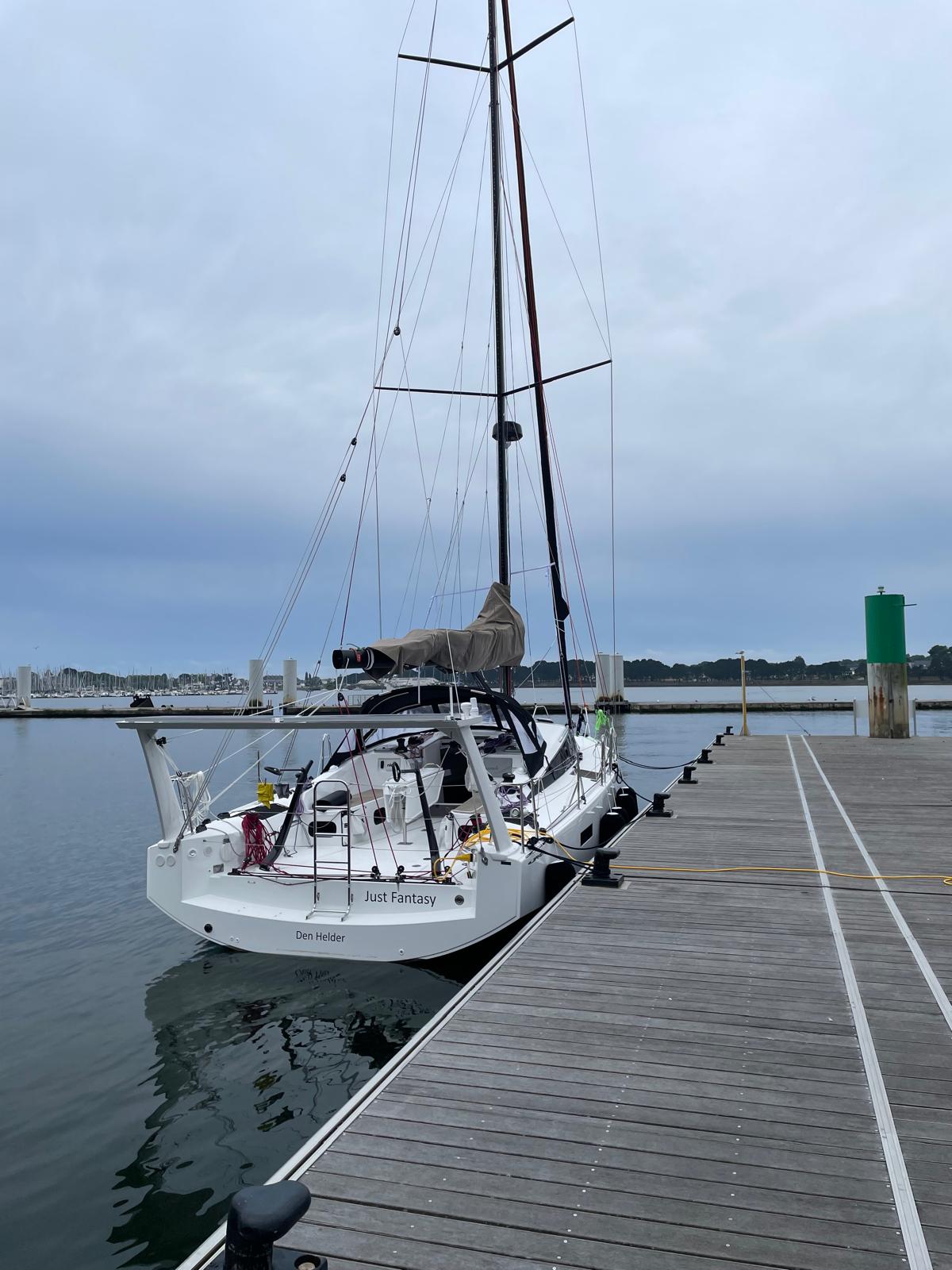
We leave the dock and as we are 100 meter out off the harbour entry …. the electric motor stops. Hmm.. I push two times on the Oceanvolt display button. A service menu screens pops up mentioning: Motor controller (0x210) missing. Seems like a communication problem. I turn the motor off and on at the nav station switch panel but nothing happens. Considering unfurling the jib or dropping the anchor, I see a capable dinghy coming out of La Base. We wave for help, and they take our bow line for a tow. Our native helpers call the harbour master successfully and 10 minutes later we thank the initial ‘rescuers’, and the marina dinghy, tied up aside at our stern, delivers us nicely to the head side of the visitors pontoon in Kernevel.
There are shallows and even a boat graveyard near by where our motor had stopped and we wouldn’t been happy ending up there. But we were glad about our decision not to leave on Saturday as the situation might have been different then. I am convinced about electric motoring and as well about the quality of JPK, Oceanvolt and E-NAV Systems. These are experienced companies. E-NAV systems has designed more Oceanvolt-Victron system at JPK, but they hadn’t commissioned and tested ours yet. And it was our decision to move on Sunday.

15th of July, Commissioning and testing Monday
For testing and setting up the Oceanvolt system the 28 kWh MG battery pack must be loaded 100%. Our shore cable has a 32A plug which was OK for the big-boat pontoon in La Base, but this marina has 16 Amp sockets. At the marina they don’t have a short cable adapter. Julien from JPK advices us to make one and so we buy the required plugs and a 30 cm 16 Amp cable and fit it together. Shore power is back.
In the afternoon Alberto Estivill from E-NAV Systems joins Aymeric from JPK to solve the comm problem. The Victron Cerbo is the central director between the Oceanvolt Hardware, the MG battery pack and the Fisher Panda diesel generator, and this one seems to malfunction at times. They disconnect all possible systems trying to isolate the problem

16th of July, Motor test & Maidensail Tuesday
A good night sleep is a good way finding the solution. Alberto suspects the power supply to the Cerbo unit and a new temporary power cable is drawn between the 48V system and the Cerbo (it can operate on 12, 24, and 48V). Problem solved.
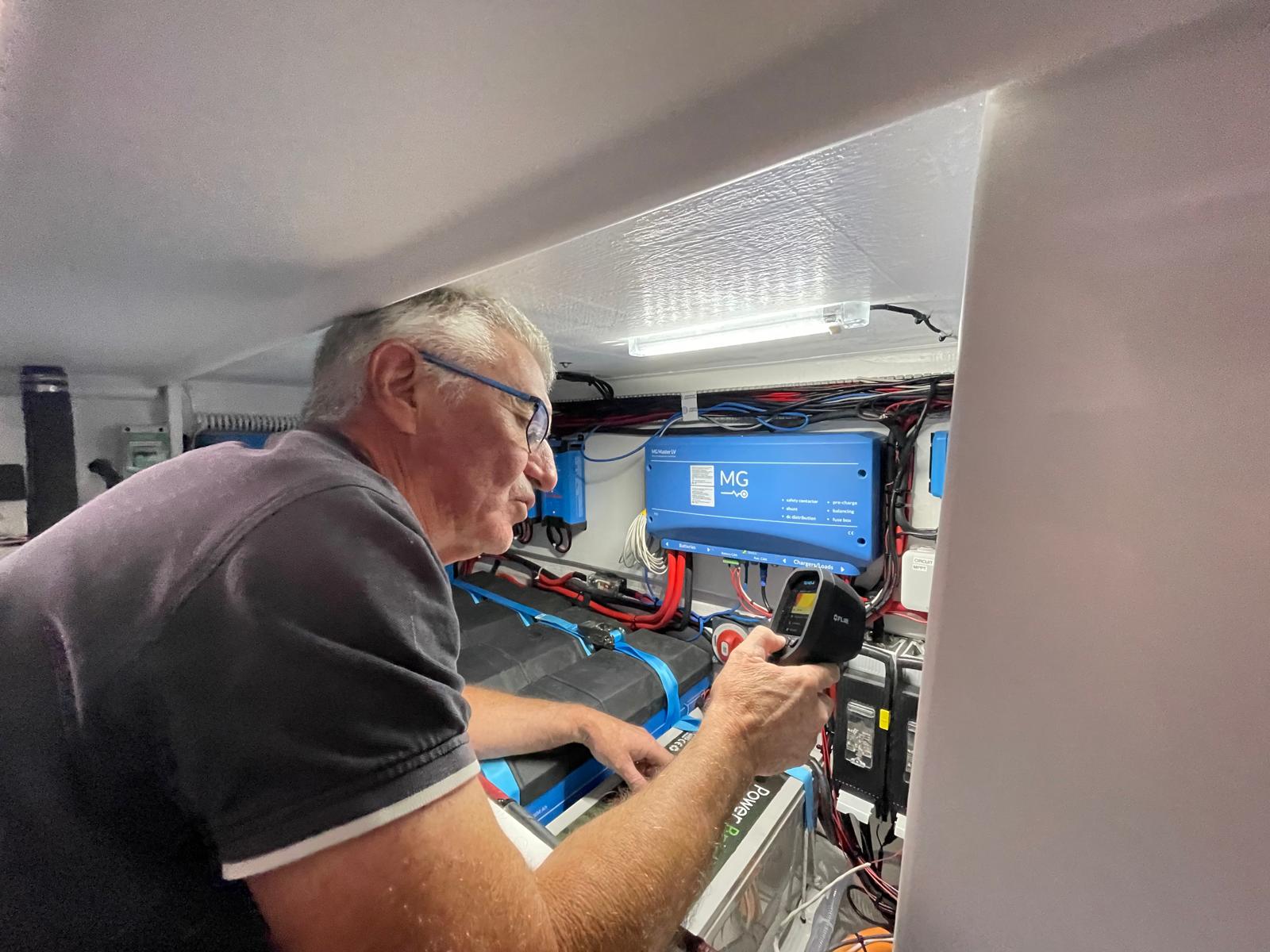
All our cables are in one cable tray and I believe this caused the problem. In my job as a building HVAC engineer, I am used that high amperage cables are separated from the communication and low amp control cables. High amp cables are put in a steel cable tray to prevent interference. Power cables of the Oceanvolt system can draw up to a max of 270 Amp, able to affect unprotected communication and DC cables. Our comm cables are shielded and should be able to coop.
As the cause of problem is found and temporary solved, Alberto is able to continue with the required commissioning tests. But first let me tell you something about the Oceanvolt system.
Propelor pitch adjustment
The propellor blades of the Oceanvolt motor have an adjustable pitch. Pitch means in this case the angle of the propellor blade when turning in the water. When the angle would be zero it doesn’t push to the water and there is no propulsion forwards. So this is not effective. On the other hand, when the angle would be 90 degrees there would be a high resistance but still no push forward. So neither effective.
The angle should be between a certain min and max degrees to have optimal push forwards and this depends on the boat speed. At a higher speed you need less pitch. So the pitch is continuously adjusted on the boat speed to get the maximum efficiency. This optimisation is not only used for propulsion, but also for regeneration. And for the latter Oceanvolt has a unique patented system.
Now back to the tests. The first is done with the ship tied up along the dock and setting the motor speed on 1.000 rpm. The power consumption should be on a certain kW level and during several tests the pitch is tweaked to come to the right consumption level. This level is the point of optimal performance.
Infrared heat measurements
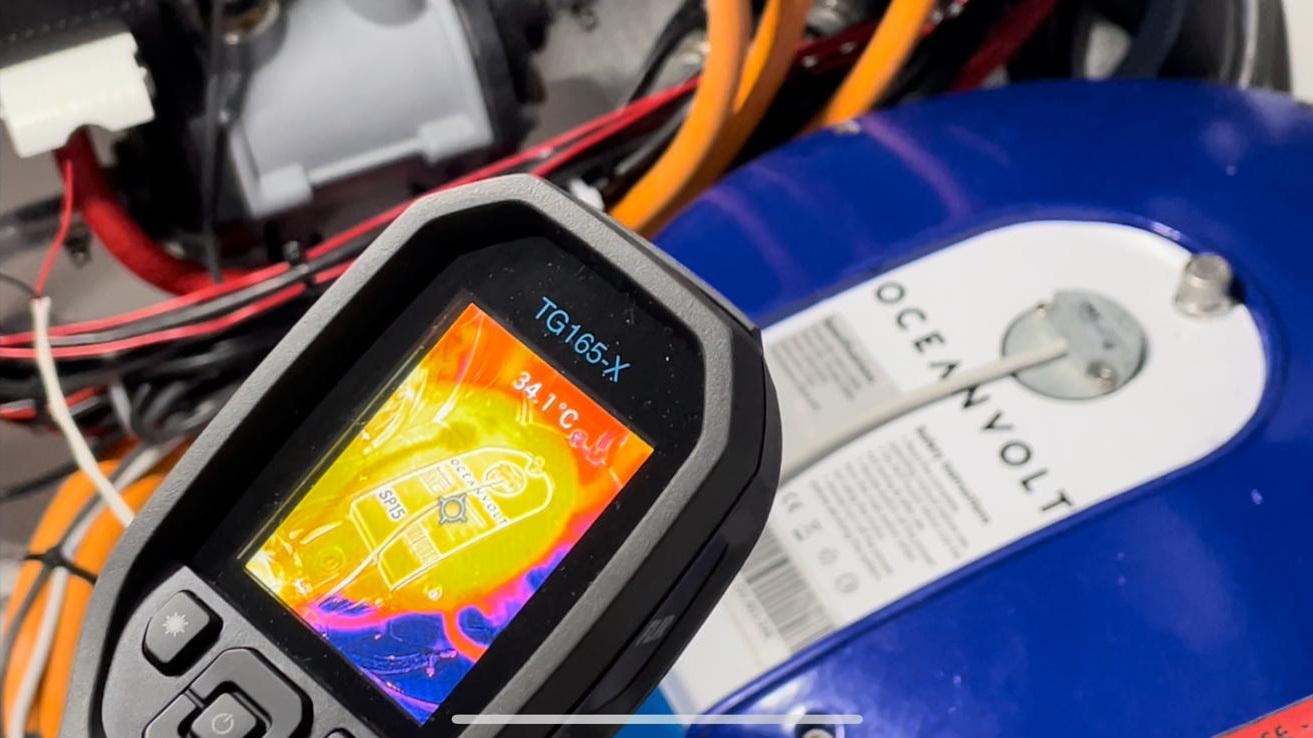
The second test is about safety. I mentioned the high Ampere levels. When at such current rates the cabling is not in the right diameter size, or the connection at plinths or in fuses is not OK you would get a huge resistance and derivative temperature increase, able to ignite the insulations and set your vessel at fire. Also for this reason I insisted in using marine grade wiring which is less vulnerable for corrosion. During this test the boat was still tied up (checked and secured) to the dock and the motor was set on maximum power forward during 5 minutes. In this situation the power draw is maximum and this is the best situation to measure the temperatures with an infrared camera. The readings give a maximum temperature of 44 degrees (able to touch).
After some other checks we leave the dock and motor upwind and downwind for extra motor tests, checking the boat speed, motor rpm and power consumption. Now it was time to set sail and test the regeneration. We hoist the wet mainsail which is shaking out rain like a wet dog, turn seawards, and then we are enthusiastically greeted by a Dutch sailing yacht. We aren’t carrying our flag, since we are not yet the owner officially, but they’re triggered by our sail number NED3920. NED stands for Nederland, 39 for JPK39 and 20 for the 20th 39-yacht .
The boat sails excellent and as we do Oceanvolt tests we have the hydrogenator on. With a wind of 4 to 5 Bf we have a speed 8 Knots and regenerate 1,2 kW, which is the same as specified in the documentation of Oceanvolt. So this test is successful. We didn’t have any motor problems on our way.
The Asymetrical spinaker is hoisted and the helming is easy. What a fun to sail this boat.


All good at the end of our maidensail day.
17th July, Hiking Wednesday
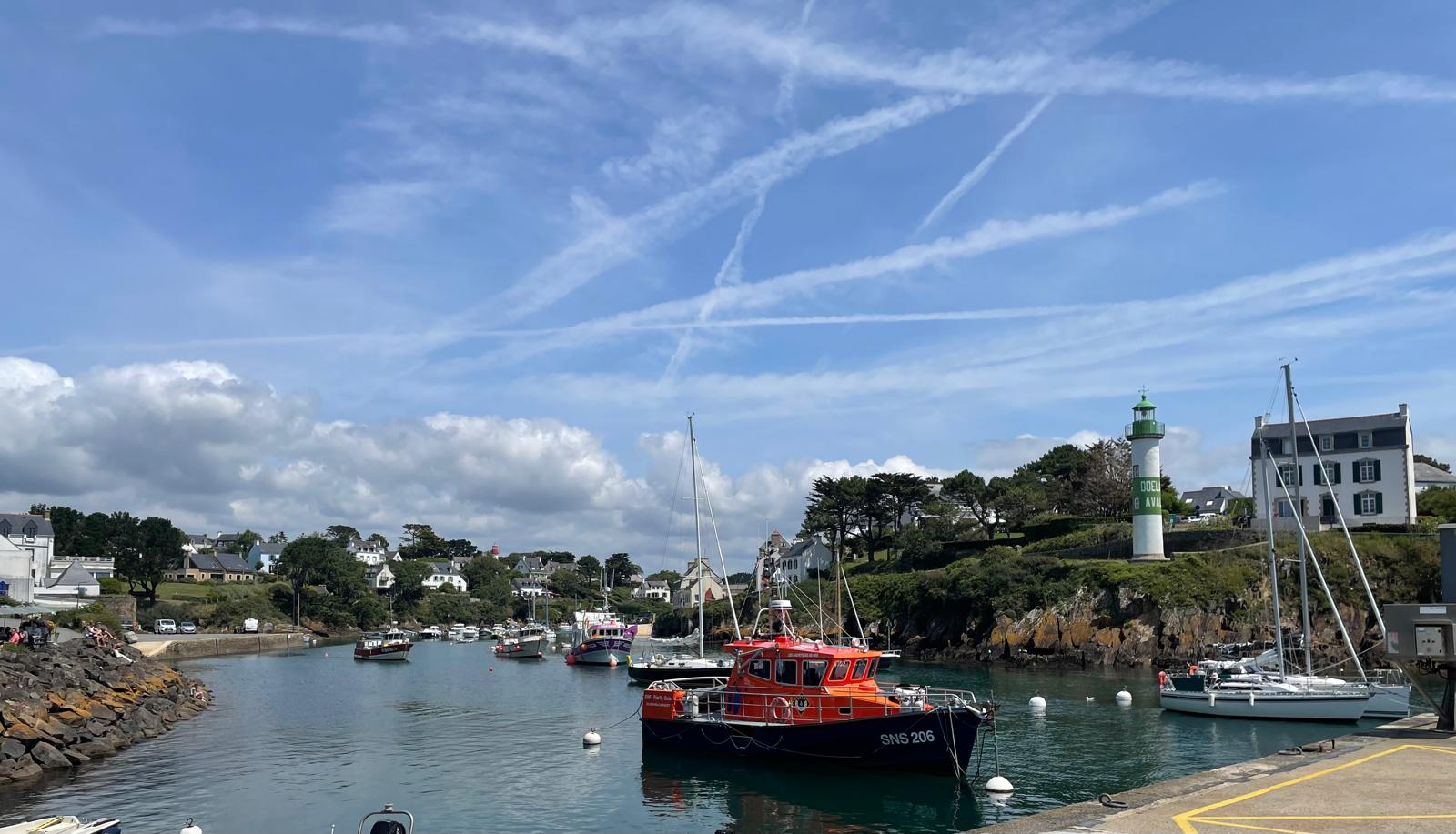
We are leaving the boat, go shopping at the chandlery, buy a 20 meter rope for the mast climbing at TG rigging, and then go for a hike alongside the coast of Doëlan, a picturesque harbour 40 km north. Aymeric from JPK worked on the boat and shortened the attention list quite a lot.
I
18th July, Private sailing Thursday
Today no one from JPK is working at the boat, we have lovely weather and around 2 Bf of wind. Perfect conditions for trial sailing. We leave the harbour take the south channel and then go upwind to Isle le Croix.
With just the two of us it is easy to sail the boat. We want to match other boats but this is not a lot of fun (too easy).
Brittany is such a lovely place to sail. We enjoy the weather and the boat and before we know it, it is time to turn back to Kernevel.
This year there are three Dutch buyers in a row for a JPK 39. Ingmar is the next, and together with his family they visit us this evening. We enjoy their fresh bought Brittany biscuits and have boat talk. What options did you choose? What have you changed from the standard? They are going to the factory tomorrow to talk about the final details. At JPK there is some flexibility. You can ask them to alter the standard, which doesn’t mean everything is possible. From our experience this is not the case everywhere. At the other shipyard, where we were before JPK, we received a no on practically all our wishes. So glad this one backed out of the agreement, … after two years on the waiting list. Many of our rejected questions were standard on the JPK option list.
19th July, North Sails Friday
In the morning TG rigging comes to install the furler for the staysail. And the manufacturer TTOP of our sprayhood comes to check the product fitting and to see if is to our satisfactory. It is. We are happy with the attention and care of JPK. The attention list is reducing.
Our scheduled morning sail is postponed to the afternoon, probably because of better wind conditions. Quentin and Willow from North Sails arrive early in the afternoon to set the stay sail (a small jib) on the new furler and to alter little details in the rigging. Then Jean-Pierre comes and we set off.
So now we are going to try the North sails, and this time without the regeneration. I am very happy with the regen result, but I am also aware it does reduce the speed with about 0,6 Knots. From last Tuesday I was under the impression it held back the ship from planing. So no regen today, speed is what we need. The breeze is up to 19 Knots. Again the south channel outward and then to Croix.

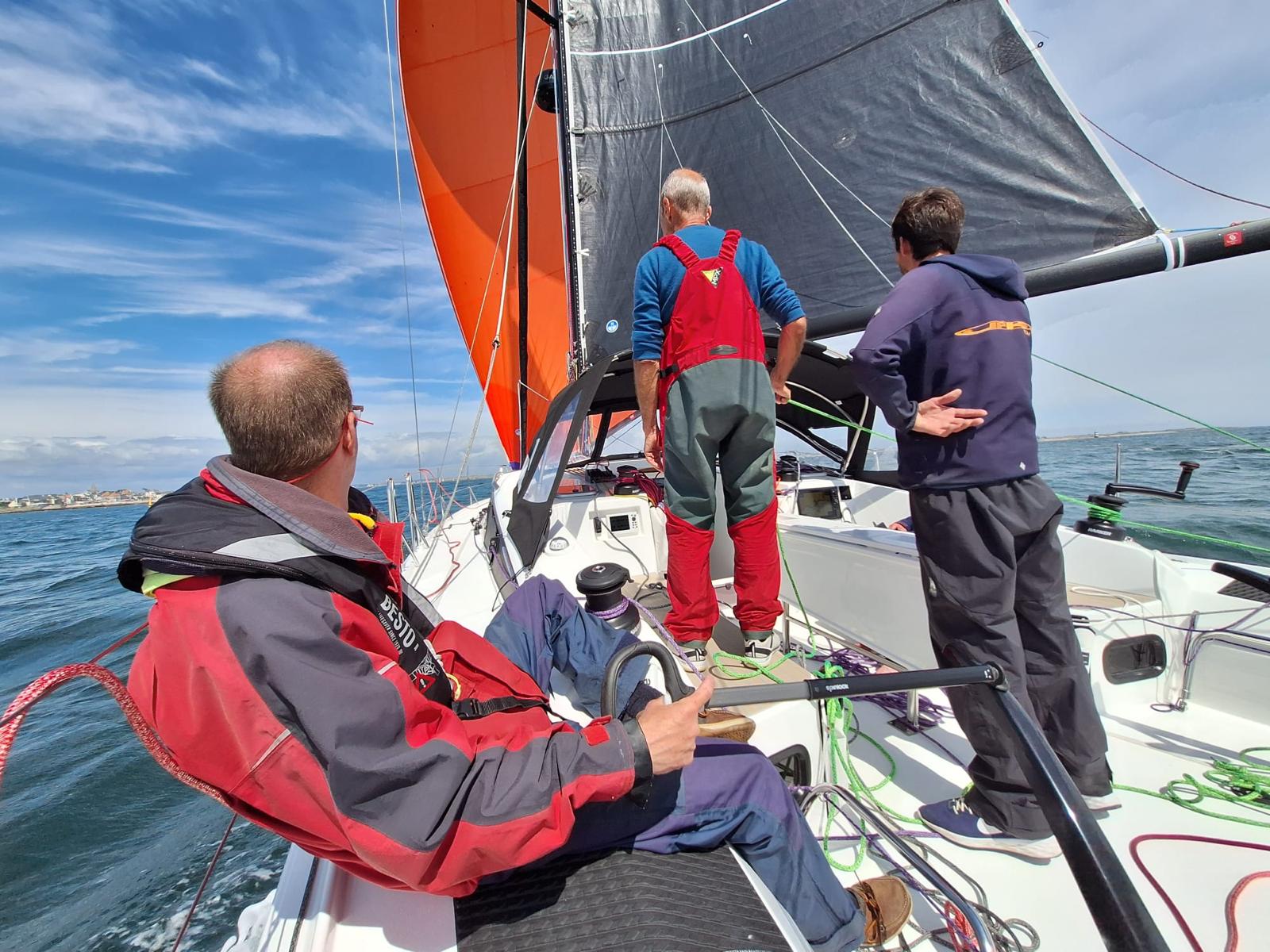
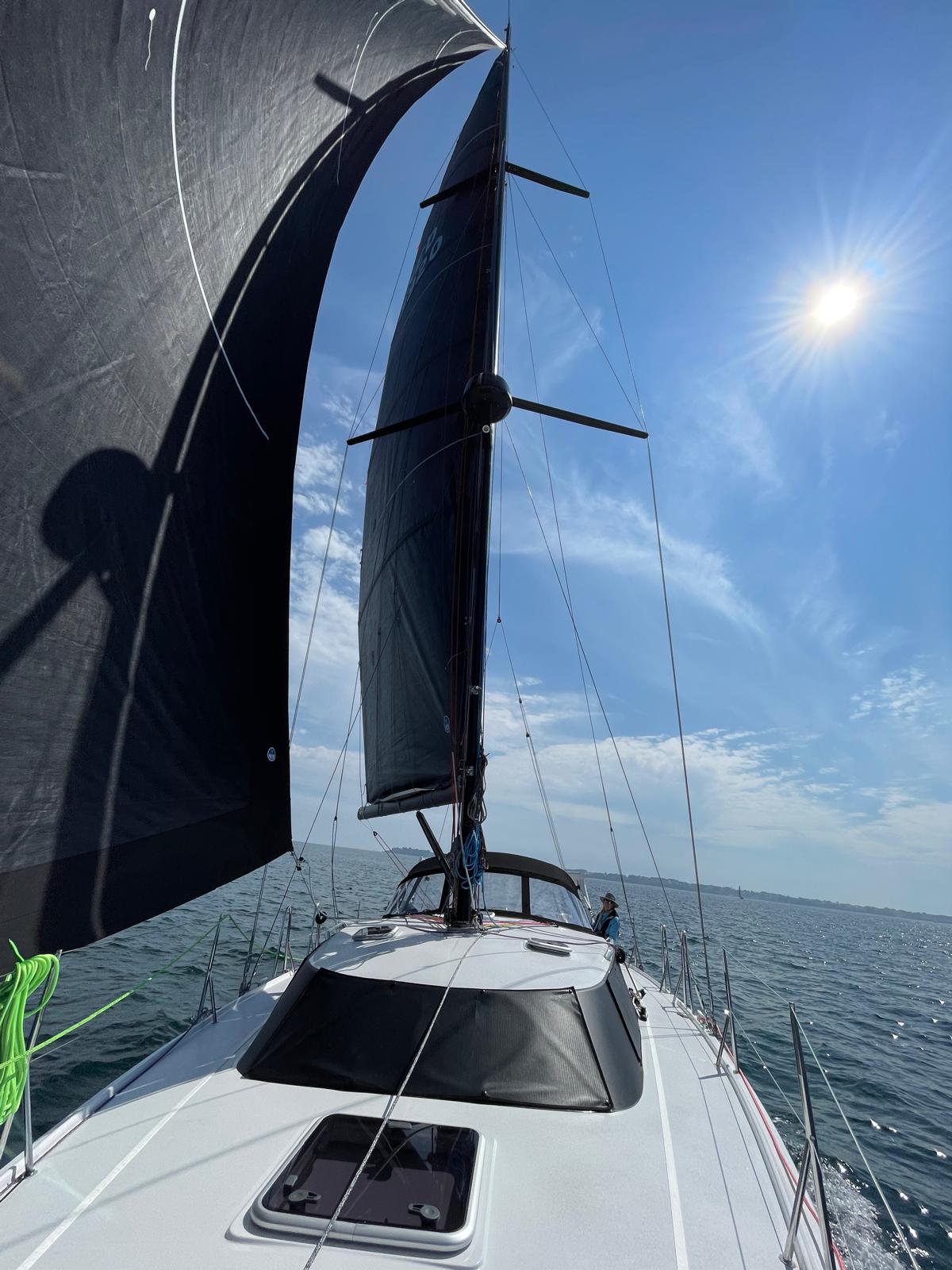
Quentin and Willow are preparing the asymmetric spinnaker. Coarse is altered to Lorient, I help to hoist the snuffer (sock around the spinnaker) and when the kite is right I go back and take the helm. There is 17 Knots of wind and our max speed is 10,2 Knots. And the boat is so easy to steer. When the wake is leaving the stern of the yacht you know it starts to plane. It overtakes its bow wave. So much fun. This is JPK, and this is what we wanted. Our gennaker is not yet right and Quentin decides not to hoist it. They will alter it and bring it back next week.
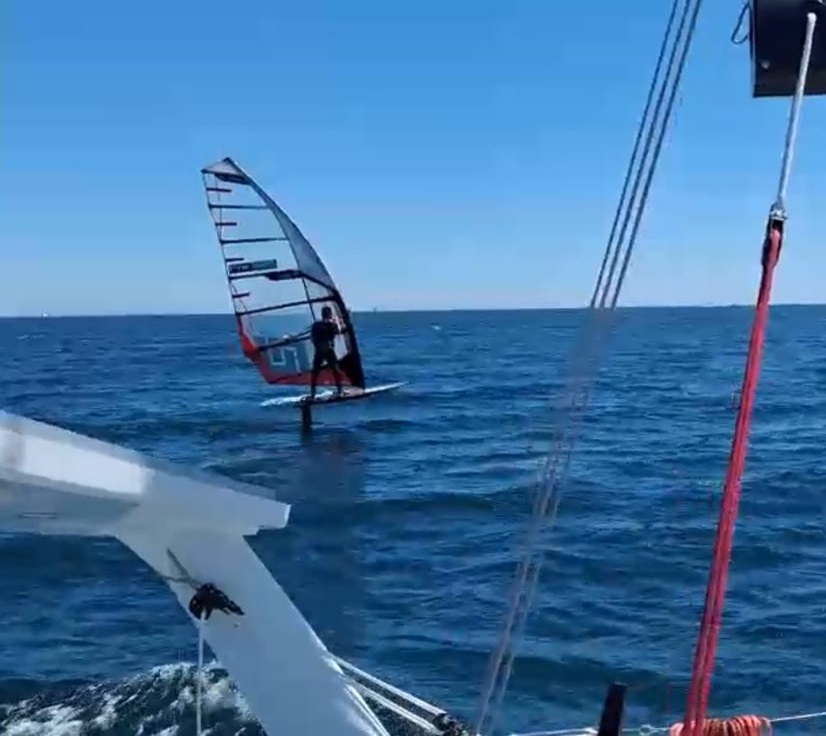
‘Look, there goes Aymeric’ says Jean-Pierre. A foiling surfboarder comes along. We wave to each other. And a little later, ‘hey there is Jean Baptiste coming’. And now we see a kite surfer coming along. We feel welcomed at these Lorient waters by the technical engineers of JPK. I ask Jean-Pierre if he is still surfing. In his younger days JP was European champion windsurfing twice and ones second in the Olympics. ‘Yes, I do. I carry an inflatable foiling board on my 45 and use it at times’.
Accompanied by JPK sailing engineers

Sailing fun at Lorient

In the afternoon Jean Baptiste phones if it is OK to come with a couple from the UK for a boat tour. They have a JPK 1010 for racing but are now looking for a family boat. When they arrive I ask the owner about the 1010 and he says, ‘if you once sailed a JPK you don’t want anything else’. Next Monday I hear exactly the same from our new neighbour, and owner of a JPK45.
We are now five days here at the dock and many came to see and gave compliments. I don’t expect this to happen that much in the Netherlands, as at home it is much more a ‘mahogany culture’ (tendency to like solid and heavy displacement boats). Well, I don’t care. We have the fun, they have the weight :).
Leave a Reply