




Factory visit at the JPK Composites shipyard
From our home at Oosterzee, it is a 1.081 km drive to the JPK Composites shipyard in Larmor Plage (Lorient). We took a Thursday and Friday off, for the first visit during the manufacturing of our JPK. Friday afternoon is the best time for a visit, because most of the JPK-Team are having an early weekend. We were wondering how far they would be with our number 20. We didn’t expect too much, while most of the staff had two weeks off, for a spring holiday.
Jean-Pierre and Jean-Baptiste welcomed us as we entered their office, and shortly after we were in the factory. We were positively surprised about the progress. We knew the infusion proces was finished, but a lot of the assembly and fitting proces was done as well.
First thing we saw, was the deck with the inner shells, standing in front of the hull. Deck holes were made for displays and other deckware. The arch, as support for the solar panels, and also being a dinghy davits, was allready stepped on the stern, and secured with anchor plates. Part of the outer cabin sides were painted black, to complete the typical JPK 39 FC ‘black sunglass’ line.
JPK Composites, the difference between a composite and a solid glass fibre boat
The deck was covered with cardboards to avoid scratching. In the cutting holes one could see the composite structure, a ~20 mm hardfoam sandwich panell with vinylester aside. The vinylester is bonded to the kernel, but also anchored to the other side through tiny pinholes, filled in the vaccuum infusion proces. The result is an ultra light weight, and stiff composite structure, which makes exactly the difference between a JPK yacht and a standard solid glassfiber boat. The quality and the finishing of the composite structures looked very good.


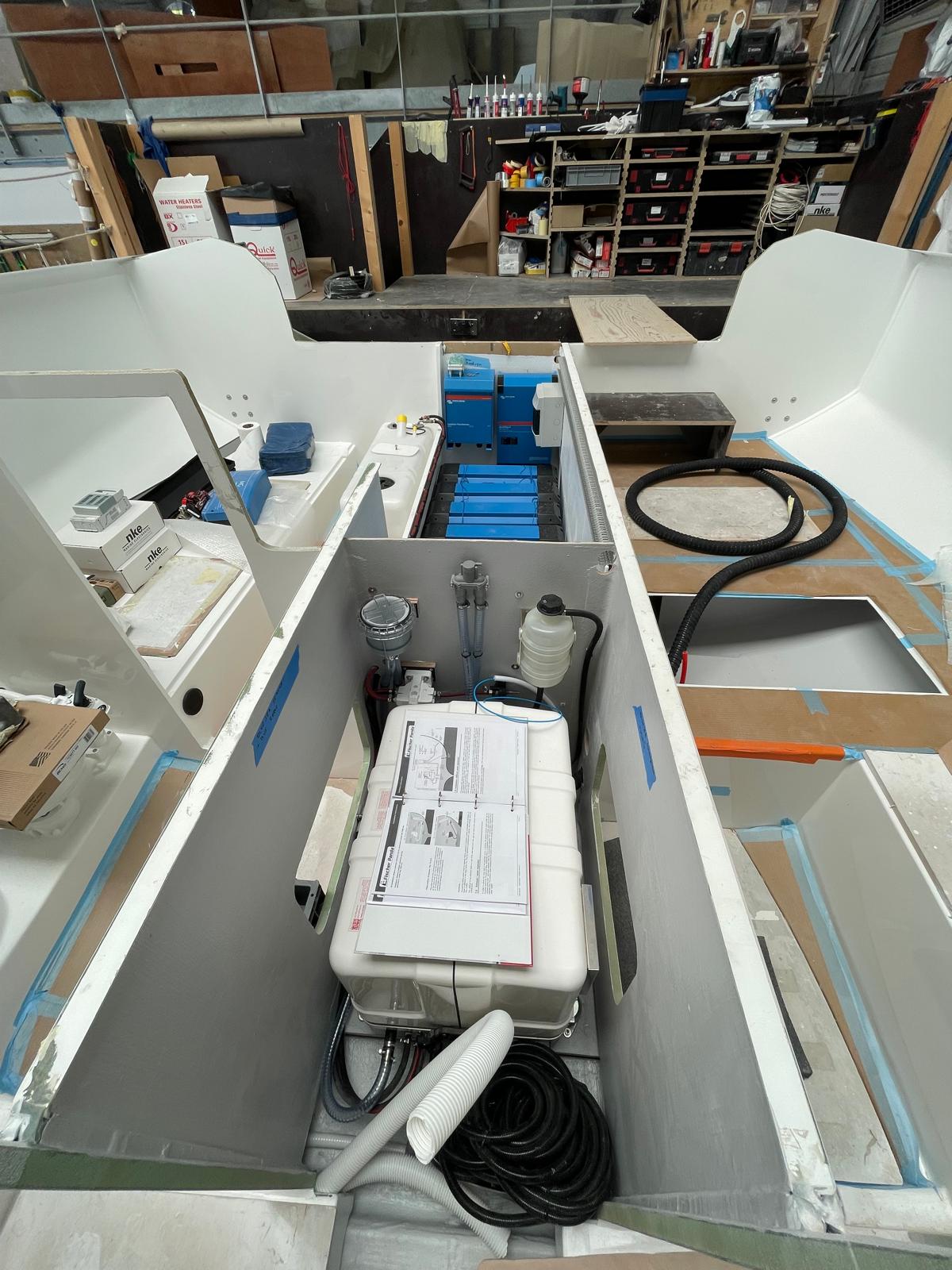
Eagerly we moved up to the hull, and we saw the plant room was allready filled with equipment. The generator was mounted on it’s base. And likewise the Oceanvolt drive-regenerator, ready to be connected to the cooling pumps. The Oceanvolt controller was mounted, and the hydraulic components of the gen-set as well. Batteries, dieseltank and Victron isolation transformer and inverter were placed. In the upcoming navstation cabinet, the electronics were installed on a mounting backwall, ready to be wired.
The kitchen counter framework was standing, mostly completed, but no drawers and fronts yet. We had asked to leave the bin drop hole out of the counter, as we prefered the waste in the keel box locker, and a kitchen drawer at this location instead. The wooden clothing cabinets were installed and protected with cardboard and bubble plastic. Also the Lewmar bow thruster was mounted.


Oceanvolt motor throttle(s)
Technicians Julien and Aymeric came in, and we walked the boat through. Before the factory coffee break we discussed the position of the throttle for the Oceanvolt engine. As this yachts has a 4 meter wide stern, we’d prefered the throttle positioned on the back of the central cockpit table, instead of on starboard side.

But Jean- Pierre was worried about possible unwinding sheets, which could get an accidental grip on the throttle. We understood that, but we were more worried about docking into a low floating pontoon on port side, and the the motor throttle being 4 meters away, on starboard side. Sigth on the nearest dock, and fingers at the throttle at the same time, gives as well peace of mind. During the coffee break Julien contacted E-Nav systems (Oceanvolt dealer) and he launched the idea to have a engine throttle on both sides. This was a very good solution, even better what we had in mind. Since this throttle is not mechanically connected to the motor (it communicates electrical), this option is feasible.
Read the previous post
Next the next post.
Leave a Reply